What sagging floor repair is
Sagging floor repair is fixing a floor that has dipped, bowed, or gone soft by repairing whatever under it gave way: the subfloor, the joists and beams that carry it, the piers and posts under those, or the foundation. Leveling the surface alone leaves that cause in place.
The work runs from patching a soft spot of subfloor to sistering joists, replacing a beam, re-shimming or adding piers in the crawl space, or lifting the house. Most of it happens from below, in the crawl space.
This page is about 1 floor, or 1 part of a floor, that sags. If a contractor says the whole house needs leveling, the house leveling guide covers that job and what it costs.
Why floors sag
Floors sag because something under them can no longer carry the load. The cost guides list the same short set of causes.
- Framing too light for its span
Older houses may have joists spaced farther apart, across wider spans, than current codes allow, or beams too small for the load on them. - Joists cut for pipes, ducts, or wires
A hole or notch in the wrong place, especially along the bottom edge or in the middle third of the joist, weakens it where the bending force is greatest. - Rot from water
Leaks, a damp crawl space, and gutters that dump water by the foundation rot the subfloor, the joists, and the sill plate the framing sits on. - Wood-eating insects
Termites, carpenter ants, and powderpost beetles can hollow out a joist or sill before anyone notices. - Supports that dropped
In a crawl space, concrete piers move as the soil under them shrinks and swells, and the wood shims on top of them flatten over the years. - Foundation settlement
The ground under the house itself settles, and the floor goes with it.
The last 2 causes matter more in central Oklahoma, where the clay swells when it gets wet and shrinks when it dries. The OKC soil guide explains why the local ground moves.
How to tell where yours starts
You can narrow it down before anyone quotes a repair. Start in the room, then look from below.
In the room
- Lay a level on the floor, or watch where a ball rolls. Note where the low spot is and how far it spreads.
- Walk it. A floor that feels springy or soft, or rattles things on a table as you pass, is losing support underneath.
- Check the walls and ceiling for new cracks, especially ones running from the corner of a window or door.
- Note which doors and windows stick. Sticking all year points to movement; sticking only in humid months may be just the weather.
- Look at the baseboards and tile. A gap under the baseboard that widens toward 1 corner, or cracked tile or grout, marks where the floor dropped.
From the crawl space
If you can get into the crawl space safely, a flashlight answers most of the question.
- Is the ground wet, or the wood dark, soft, or crumbling? That is water or rot.
- Is there a joist under the low spot that was cut or notched for a pipe, duct, or wire?
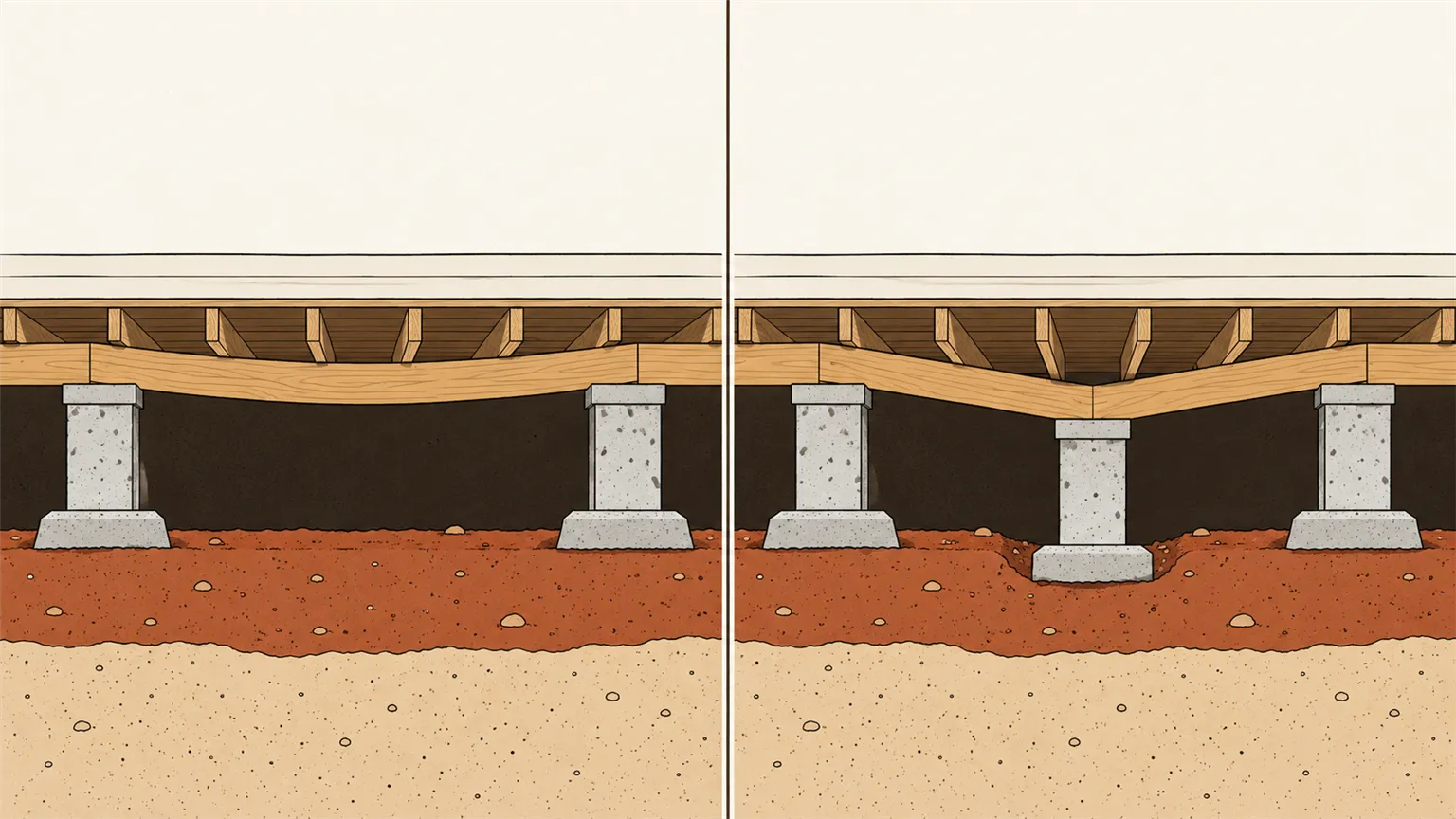
- Is there a pier or post under the low spot that leans, sits lower than its neighbors, or has crushed shims on top?
- Or do the piers look level and sound while the wood between them bows down?
Those last 2 checks are the split in the diagram above. Wood that bends between sound supports is a framing repair. A support that dropped under sound wood is a pier repair, and if several piers have dropped, the problem may be the foundation.
Sagging, sloping, or uneven?
People use the words for the same thing, and the causes overlap. What changes the answer is what your house sits on.
A crawl-space house, with piers and beams under a wood floor, has all the causes on this page; the pier and beam foundation guide shows how that kind of house is built. A slab house has no joists under the ground floor, so a ground floor that dips on a slab means the slab under it moved, and that is a foundation question.
Out of level alone doesn't prove anything is moving. The Foundation Performance Association notes that most house slabs are built within about 1 inch of level, and that a floor out of level with no cracks, sticking doors, or other damage may simply have been built that way. Its advice for that case is to check the floor's elevations every few months before you repair anything.
An upstairs floor that dips has no foundation under it at all. That sag is in the framing, and the signs guide covers it with the other symptoms that look like foundation trouble but aren't.
The fixes, and what each one solves
Each fix matches 1 cause. The expensive mistake is paying for a fix that matches a different one.
| Fix | What it solves | When it's the wrong fix |
|---|---|---|
| Subfloor repair | A soft spot in the plywood layer, often from a leak | The joists under it sag too |
| Sistering joists A new joist fastened alongside a weak one | 1 or 2 weak or bowed joists with a small sag | More than a few joists sag, or the wood is rotted, which calls for replacement |
| Replacing joists or a beam | Framing rotted by water, eaten by insects, or badly cut; beams are often replaced with steel | The wood is sound and a support under it dropped |
| Adding or replacing posts | A span too long for its supports, or a failed post | Done in a hurry: the lift has to go slowly, over a couple of weeks |
| Re-shimming or adding piers | A crawl-space pier that moved with the soil, or shims that flattened | The joists or sill plate above are damaged, which gets fixed first |
| Leveling the house | Many supports dropped, or a slab house whose slab moved | 1 area sags and the rest of the house is level |
The fixes and their limits follow Fixr's guide to diagnosing sagging floors and its floor repair cost guide. Replacing framing with treated lumber, shimming on the pier caps, and adding supports are also on the engineers' pier-and-beam repair list in the ASCE Texas guidelines.
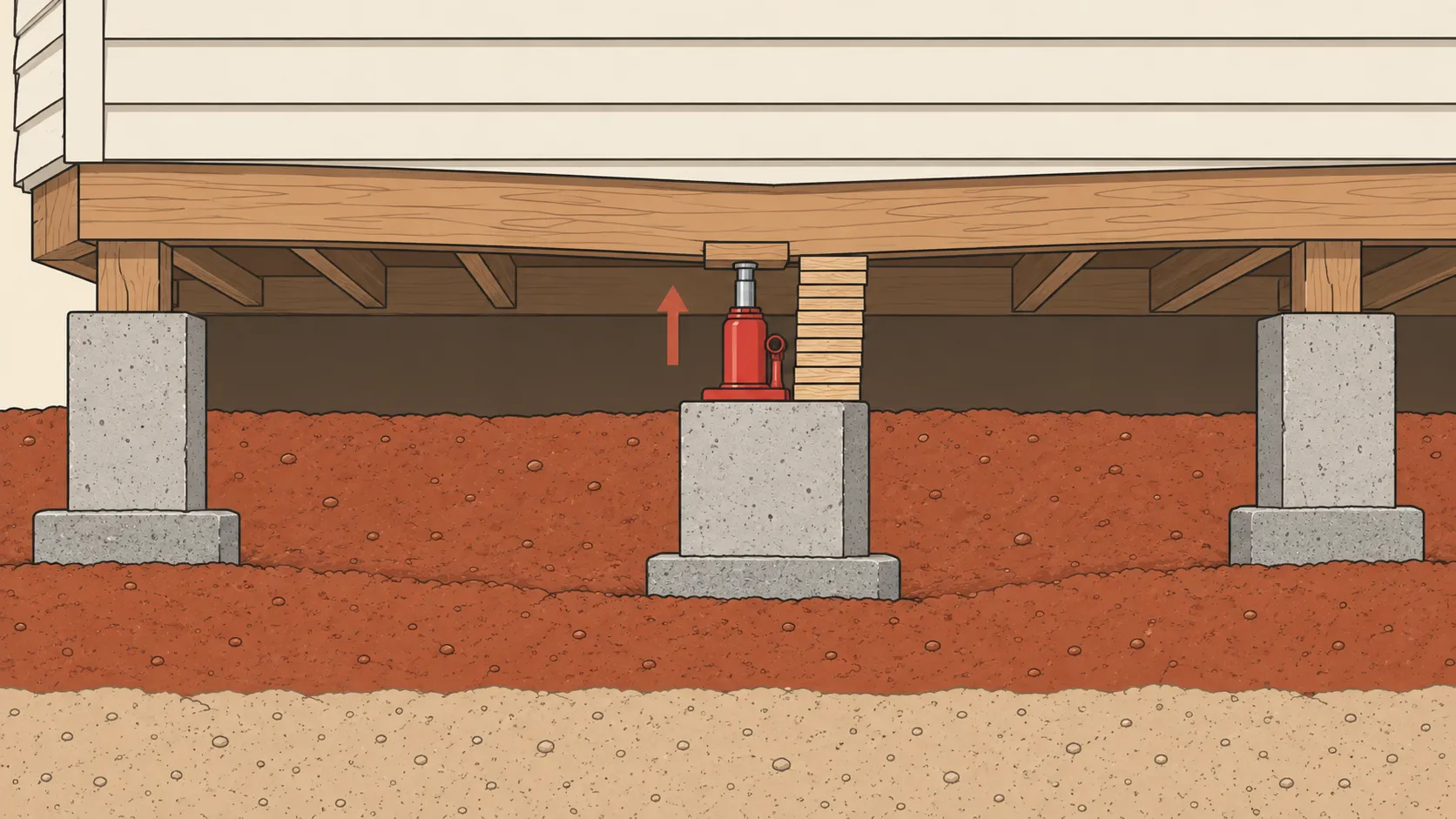
Framing fixes rarely stop at 1 joist. Fixr notes it is very uncommon for a single joist to fail alone, and that bracing one side of a floor stresses the other unless both are done together.
When the answer is lifting the whole house, the house leveling guide covers both ways it's done and what each costs.
What sagging floor repair costs
Nationally, most sagging floor repairs cost about $1,000 to $8,500, according to Angi's 2026 cost data. The cause moves the price more than anything else.
| What caused the sag | Typical repair cost (US) |
|---|---|
| Subfloor damage | $100 - $700 |
| Termite damage | $1,000 - $10,000 |
| Water damage | $1,350 - $6,275 |
| Foundation damage | $2,200 - $8,000 |
| Joist or post damage | $4,000 - $12,000 |
Figures are from Angi's sagging floor repair cost guide (updated Aug 2026). They are national.
By the joist, Fixr puts joist repair at $500 to $2,000 per joist. At the top end, Angi says replacing rotted joists across a whole floor can pass $20,000, and Fixr's range for sagging floors overall runs $2,000 to $20,000.
The cause can add its own bill. Angi puts mold remediation at $1,200 to $3,750 and termite treatment at $250 to $1,000, and flooring pulled up for the repair may need replacing.
Closer to home, the OKC prices on file are for whole-house crawl-space work, not a single sag:
- Pier-and-beam lift, Apr 2024
$12,000 to $20,000 for 7 hydraulic lifts plus 12 interior screw jacks. Bought a house back in late September and after those couple little earthquakes, realized some cracking was happening that seems to have been previously patched. Did have a structural engineer during the buying process who recommended some eventual repairs. Pier and beam crawl space home. Had ramjack come out with an initial quote or $12-20k. [...]Source ↗ - Complete pier-and-beam redo, Aug 2022
$10,000 to $20,000, as an Oklahoma homeowner put it. The shifting soil is the reason you have pier and beam and not concrete slab foundation. The key difference is that you can pay 10-20k to completely re-do your pier and beam foundation. Fixing a concrete slab foundation can easily be between 50-100k. Neither foundation type "fixes" a shifting soil problem, there's really nothing to be done about that.Source ↗
For OKC prices across every repair type, with dated homeowner reports, see the cost guide.
Can you fix a sagging floor yourself?
A small part of it. Sistering 1 or 2 weak joists under a small sag is a job a handy owner can do.
Past that, bring in a pro. Fixr's guide says to call for backup if more than a few joists sag, because that points to a bigger problem. Damaged beams are a foundation contractor's job.
Jacking a floor back up is the step that goes wrong most easily. It can't be done in an afternoon: the lift has to go slowly over a couple of weeks, ideally with an engineer overseeing it. Done fast, it can crack the drywall and the floor coverings above.
Either way, the same guide recommends a structural engineer first, whether you do the work or hire it out. The engineer names the cause and can draw up the plan, including how to support the floor while the work is done.
What an owner can do to help
- Find and stop any leak, and dry out the crawl space.
- Make the crawl space easy to reach, and light it.
- Mark where plumbing and wiring run, so nobody cuts into them.
- Clear furniture and rugs off the floor above the work.
Fixr says a floor repair is unlikely to need a permit unless it includes major structural changes, with replacing floor joists a possible exception.
Oklahoma City's own rule is broader. The city requires a permit to construct, alter, repair, enlarge, move, or demolish a structure, and a residential building contractor must be registered with the city to work inside city limits. Check with the city's Development Center before structural work starts.
Fix the water first
Water is behind many sagging floors, and a repair made over a wet crawl space rots out the same way.
Fixr's advice is to deal with the moisture first, then repair the framing in a dry space. The engineers' pier-and-beam repair list in the ASCE Texas guidelines names 3 parts to keeping a crawl space dry:
- Cross ventilation, so damp air moves out.
- Drainage under the floor, so water doesn't stand on the ground.
- Clearance between the soil and the wood, so the framing doesn't sit in the damp.
Outside, the same rules as any foundation apply: gutters that aren't clogged, downspouts that empty well away from the house, and soil sloped so rain runs away. Ask any contractor what the plan is for the water under your floor.
◆ Before anyone jacks it up
Name the cause before you price the fix
Unless the problem is plainly a soft spot of subfloor, Angi's cost guide recommends having a structural engineer inspect the framing. A contractor who sells piers sees piers; a carpenter sees joists. An engineer has nothing to sell.
An independent structural engineer's report runs $200 to $500 and names the problem and the fix. In OKC, one homeowner's engineer inspection and detailed report came to about $200 plus $200. Gary McCracken with Metro Engineering did fine work. Nice guy; makes things easy to understand. Not sure what his prices are now, but when I used him, it was just shy of $200 for the inspection and summary and another $200 for the detailed report, diagram, etc.Source ↗
Read the engineer-first guide →Floor sagging in OKC? 1 contractor, not 5.
Free to you. The contractor pays us a referral fee, never a markup.
FAQ
How much does it cost to fix a sagging floor?
Nationally, most sagging floor repairs cost about $1,000 to $8,500, according to Angi's 2026 cost data. A simple subfloor patch can be about $300, and replacing rotted joists across a whole floor can pass $20,000. Fixr puts joist repair at $500 to $2,000 per joist. The cause sets the price, so the first money is best spent finding out what gave way. These are national figures, so an OKC quote can land higher or lower.
Can you fix sagging floors yourself?
Sometimes. If only 1 or 2 joists are weak and the sag is small, sistering them is a job a handy owner can do. If more than a few joists sag, a beam is damaged, or the floor has to be jacked up, bring in a pro: jacking has to go slowly, over a couple of weeks, and ideally with an engineer overseeing it. Either way, have a structural engineer name the cause first.
Will homeowners insurance cover sagging floors?
It depends on what caused the sag, and on your policy's wording. The Insurance Information Institute says a standard policy won't cover damage from lack of maintenance, mold, or termites and other pests, and most policies exclude earth movement. Sudden water from a plumbing system is a different matter: accidental discharge of water from plumbing is one of the standard covered perils. Read your policy or ask your agent before you assume either way.
Why is my floor sagging in one spot?
A sag in 1 spot usually has a cause in that spot. The common ones are a leak that softened the subfloor or rotted a joist, a joist cut or notched to run a pipe, duct, or wire, a pier that sank or shims that flattened under a beam, and termites or other insects in 1 section of framing. Look under that spot from the crawl space if you can do it safely.
Who do I call for a sagging floor?
Start with a structural engineer if you don't know the cause, because the cause decides the trade. A carpenter handles subfloors and joists, and a handyman can take a small subfloor patch. A foundation contractor handles beams, piers, and anything that means lifting the house. In OKC, if the engineer points to the piers or the foundation, RestoreCast can match you with 1 foundation contractor.
What a standard homeowners policy covers, cause by cause, is in the foundation repair insurance guide.