The short answer: the ground under your house moves
Oklahoma City foundations fail because of the soil, not because of the builder. The clay under most of the metro is expansive: it swells when it takes on water and shrinks when it dries out, growing to 1.5 to 2 times its dry size through the cycle. When one part of the house sits on ground that is swelling while another sits on ground that is drying, the two move by different amounts, and that uneven movement is what opens cracks in brick, drywall, and slabs. A house that moves as one piece does not crack; a house on soil that moves unevenly does.
Everything on the rest of this page follows from that one fact. The seasons, the trees, the downspouts, the plumbing leaks all matter because of the same thing: they change how wet the ground is, and changing the moisture is what moves the house.
Oklahoma's red clay, and why it swells
The red dirt is famous, but the color is not what matters to your foundation. It is the clay. The Oklahoma Geological Survey says over 75 percent of Oklahoma's bedrock units can produce expansive soil, and that central Oklahoma's Permian formations, the red shale the metro is built on, carry moderately high shrink-swell potential. Weathered down, that bedrock becomes the clay a house sits on.
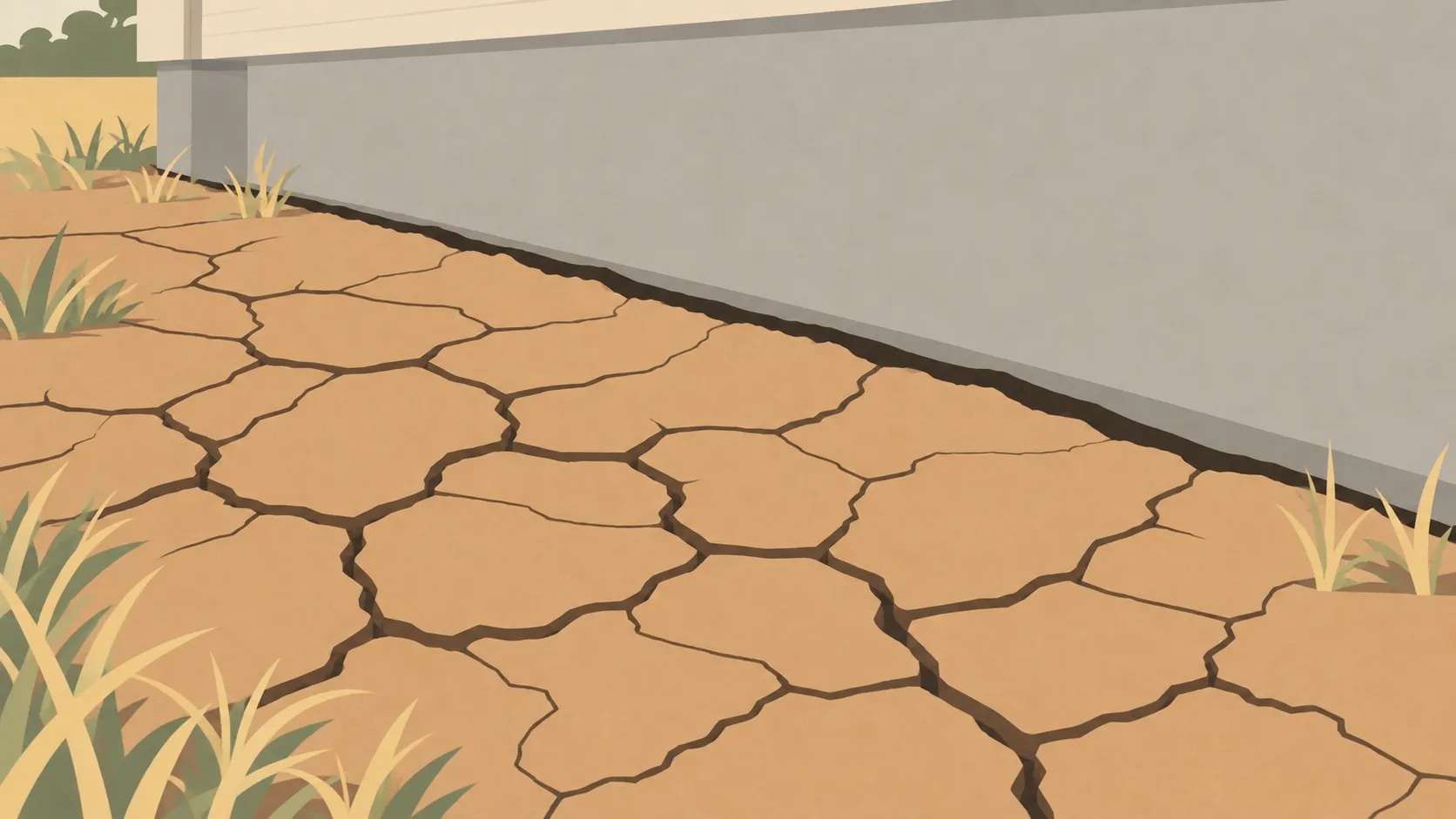
Expansive clay works like a dry sponge. Add water and it swells, and it swells with real force, enough to lift a corner of a house. Take the water away and it shrinks and pulls back down, and a gap can open between the soil and the foundation. Over a wet spring and a dry August, the same patch of ground can rise and fall by inches. That is normal Oklahoma weather acting on normal Oklahoma clay; the house just happens to be sitting on top of it.
| Part of the metro | What is under it | What it means for your house |
|---|---|---|
| West Oklahoma City and the older core: downtown, Capitol Hill, the west side, southwest toward Moore | Kirkland, Renthin, Renfrow, and Piedmont clay, weathered from the red shale under town, about half clay by weight. | Moves a lot. This is the soil that cracks foundations. The USDA gives it its worst rating for house foundations and names swelling and shrinking as the reason. Keep water away from the foundation and keep the ground around it evenly moist, and get an engineer's report before any repair quote. |
| Scattered pockets through the west and northwest county | Watonga and Waurika clay, the heaviest shale clays in the county. | Moves the most. Same worst rating, at the very high end of the scale. The same care matters more here. |
| North and central terraces and low hills | Norge, Vanoss, Grant, and Kingfisher: loamy soils with less clay. | Moves some. The USDA's middle rating: manageable with ordinary drainage care and design. |
| East Oklahoma City: Midwest City, Del City, Choctaw, and eastward | Stephenville, Darnell, and Harrah: sandy soil over sandstone, the Cross Timbers country. | Barely moves. The USDA's best rating for house foundations. If a house out here shows foundation signs, look for a water source first: a plumbing leak, a downspout, a big tree close to the house. |
| The North Canadian River corridor and creek bottoms | Yahola, Pulaski, Dale, Ashport, Lomill, and Miller: silty and clayey soil the river left behind. | Moves some to a lot, and floods. The USDA's worst rating here is mostly about flooding, though the bottomland clays swell too. |
The parts of town are approximate. We read the map in broad strokes, not lot by lot, so a street near a boundary can differ from its neighbors. The soil under your own lot is what counts, so look it up. For one suburb mapped street by street, see the soil under Norman.
The numbers behind this map
The USDA measures how much a soil swells and shrinks as a percentage of its size (it calls this linear extensibility), averaged over the 10 to 40 inches below the surface: under 3 percent is low, 3 to 6 moderate, 6 to 9 high, 9 and up very high. Its foundation rating ("Not limited", "Somewhat limited", "Very limited") is the USDA's own verdict for a house on ordinary concrete footings about 2 feet deep. "Very limited" means the problems "generally cannot be overcome without major soil reclamation, special design, or expensive installation procedures."
| Soil | Swell and shrink | Clay | USDA foundation rating |
|---|---|---|---|
| Watonga, Waurika | 9 - 17 percent (very high) | 50 - 52 percent | Very limited, for swelling and shrinking |
| Kirkland, Renthin, Renfrow, Piedmont | 6 - 8 percent (high) | 44 - 50 percent | Very limited, for swelling and shrinking |
| Grainola, Huska, Newalla | 6 - 8 percent (high) | 40 - 58 percent | Very limited, for swelling and shrinking |
| Norge, Vanoss, Grant | 3 - 4.5 percent (moderate) | 31 - 38 percent | Somewhat limited |
| Kingfisher, Harrah | 2.7 - 4.5 percent (low to moderate) | 26 - 33 percent | Not limited to Somewhat limited |
| Stephenville, Teller, Konawa | 1.5 - 3 percent (low) | 24 - 32 percent | Not limited |
| Darnell | 1 percent (low) | 12 percent | Somewhat limited, shallow bedrock (not swelling) |
| Miller, Lomill (river bottoms) | 5 - 7.5 percent (moderate to high) | 47 - 50 percent | Very limited, for flooding and swelling |
| Dale, Ashport (river bottoms) | 3 - 4.5 percent (moderate) | 25 - 32 percent | Very limited, mostly for flooding |
| Yahola, Pulaski (river bottoms) | 1 - 1.5 percent (low) | 14 percent | Very limited, for flooding |
How water turns a small problem into a big one
The damage is not caused by water, exactly. It is caused by uneven water: one side of the house wet, another dry, and the two ends of the slab riding at different heights. A yard that drains evenly and stays evenly moist can sit on bad clay for decades without trouble. A yard where a downspout dumps at one corner, or a slow plumbing leak feeds one edge, is where the movement concentrates.
Small water problems become big ones faster than people expect. The engineers who write the drainage guidelines note that the clay near the surface is fractured by old roots and cracks, so it is more permeable than the solid clay below: ponding water can work its way tens of feet under a house in a matter of months, not years. A puddle that keeps forming by the foundation after every rain is not cosmetic; it is feeding the exact process that moves the house.
What the moving ground does to your house
When the ground rises and falls unevenly, the house has to bend to follow it, and the weakest, most brittle parts give first. That is why the classic signs cluster the way they do: stair-step cracks in brick, diagonal cracks running from the corners of doors and windows, doors that stick in one season and swing free in another, gaps opening at the top of a wall. Each one is the house telling you which part of the foundation moved.
Trees are the single biggest culprit, and the slowest. One engineering maintenance guide attributes the majority of repair-requiring foundation problems to trees, because a big tree pulls large amounts of moisture out of the clay on its side of the house and dries that ground out while the rest stays wet. A tree planted close to a new house often does not show up as a foundation problem until it matures, 10 to 20 years later.
Not every crack is a foundation crack, and most cracks are not structural. Which signs actually matter, and which look alarming but are normal, is its own guide: signs of foundation problems, and what is normal.
Look up the soil under your own address
You do not have to guess which clay is under your house. The USDA has mapped the soil under nearly every address in the country, and the lookup is free. Type your address into the USDA's Web Soil Survey and it names the soil under your lot, down to 5 to 7 feet, including how much it shrinks and swells. The engineers who write the foundation drainage guidelines point homeowners to that same tool, so it is not a sales gimmick; it is the primary record.
What you are looking for is the shrink-swell rating and the "Dwellings Without Basements" rating. A soil rated "Very limited" for that use, with swelling and shrinking named as the reason, is the clay this whole page is about. A sandy soil rated "Not limited" barely moves, and if a house on that ground shows foundation signs, the first suspect is a water source (a leak, a downspout, a close tree), not the soil.
A worked example. We ran that lookup across one metro suburb and turned it into a plain-English map: which part of Norman sits on clay that moves a lot, some, or barely. The same USDA data exists for your own address.
What you can do about it
You cannot change the clay, but you can control the one thing that moves it: how wet the ground stays, and how evenly. The whole aim is uniform moisture all the way around the foundation, so no part of the house rises or falls faster than the rest. These are the measures the engineering guidelines list, in plain terms.
The dirt right against the house should fall about 6 inches over the first 10 feet (a 5 percent slope), so rain runs away from the foundation instead of pooling against it. Fixing negative grade, where the yard tilts back toward the house, is the highest-value, lowest-cost thing most owners can do.
Keep gutters clean and extend downspouts so they discharge 5 feet or more from the foundation, not straight down at the corner. A single downspout dumping at one spot is a classic way to wet one side of the house and start uneven movement.
In a long drought, water the ground evenly all the way around, 1 to 2 feet out from the foundation, never into the gap that opens between the soil and the slab when the clay pulls back. Keep flower beds and soil about 6 inches below the top of the foundation so water is not held against it.
Topping a low, clay-bottomed area with loose sand or topsoil traps water against the house like a bathtub, the opposite of what you want. Regrade the clay to drain instead.
Plant large trees well away from the house, and be careful about removing a mature one close to it. The ground a big tree kept dry can swell back up once the tree is gone, causing its own movement, so get advice before cutting one down near the foundation.
More water is not better. The goal is steady, even moisture, not soaking the ground, and the same engineers who recommend watering in a drought caution against overwatering. Trying these non-structural measures before committing to major structural repair may itself be the prudent move.
◆ The trust pillar
Before any free inspection
The free inspection is the first step of the sale, so take it last.
If the signs are real, pay an independent structural engineer $200 - $500 for a report before you call the repair companies. The findings are yours, measured against published standards, and they tell you whether the fix is drainage and watering or actual underpinning, before anyone with piers to sell defines the job for you.
Read the engineer-first guide →Ready for a quote? 1 OKC contractor, not 5.
Free to you. The contractor pays us a referral fee, never a markup.
FAQ
Why does Oklahoma City have so many foundation problems?
The ground. Over 75 percent of Oklahoma's bedrock can produce expansive clay, according to the Oklahoma Geological Survey: soil that swells when it gets wet and shrinks when it dries, growing to 1.5 to 2 times its dry size. A house built on it rides up and down with the weather, and uneven movement under one part of the house is what cracks a foundation. It is rarely bad construction; it is what the house sits on.
Can I stop my foundation from moving?
You cannot change the soil, but you can steady its moisture, and steady moisture is what keeps the ground from moving. Engineers say the goal is uniform moisture around the whole foundation, not more water: keep gutters and downspouts carrying water well away, grade the ground so it falls away from the house, and avoid soaking one side while another stays dry. Trying these non-structural measures before major structural repair may be prudent.
Do trees cause foundation damage?
They can. One engineering maintenance guide attributes the majority of repair-requiring foundation problems to trees, and a tree planted near a house often shows up as a problem 10 to 20 years later as it matures and pulls moisture from the soil. Removing a large tree can cause its own trouble: the ground it kept dry can swell back up, so get advice before cutting one down near the foundation.
Should I water my foundation?
In a long dry spell it can help, but uniformity matters more than volume. The engineering guidance is to keep moisture even all the way around the foundation rather than to flood it, and to be careful not to overwater, because too much water is its own problem. A soaker hose set a foot or two out from the foundation, run evenly on all sides, is the usual method.