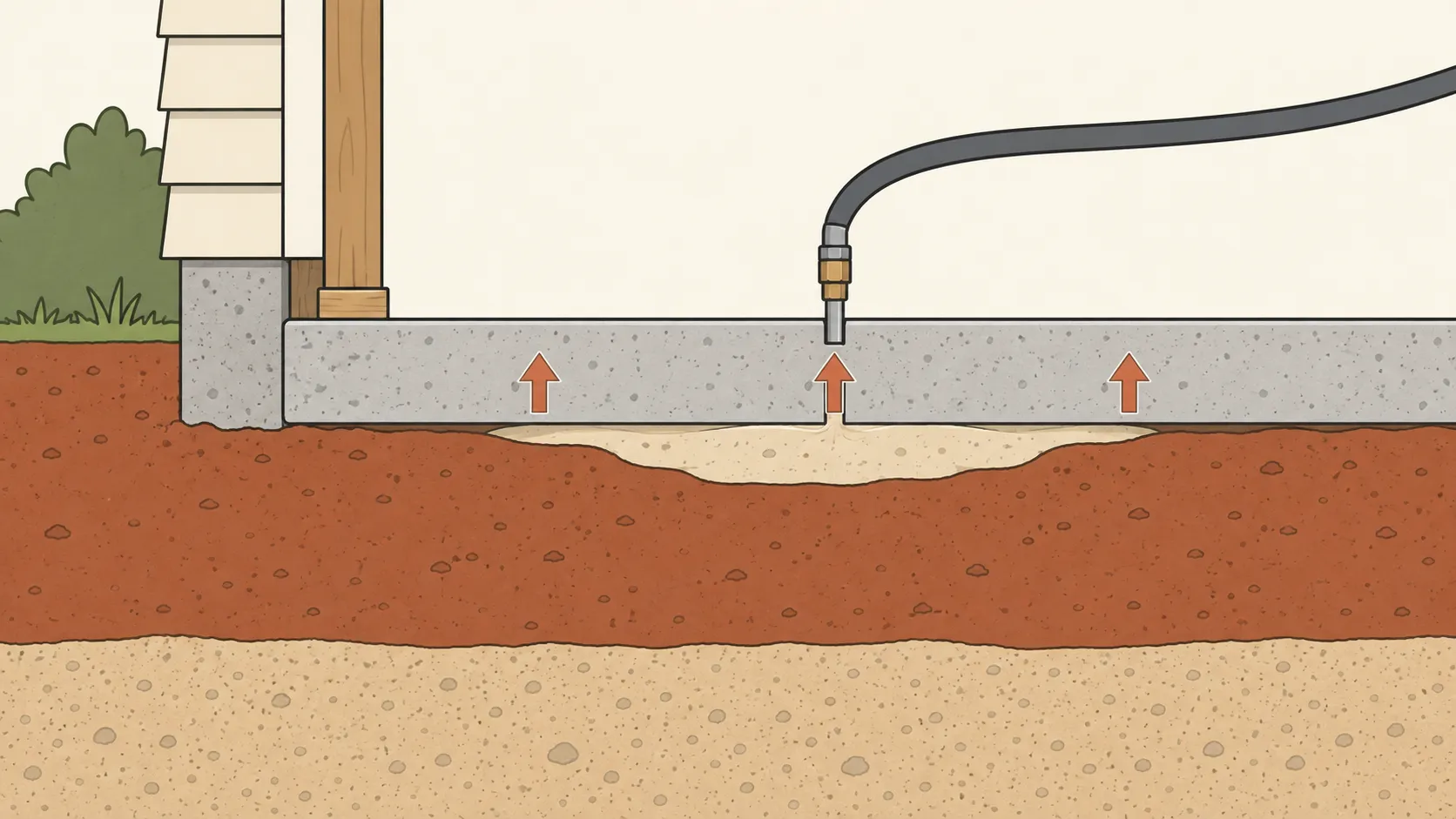
What mudjacking is
Mudjacking is a way to lift a sunken concrete slab by pumping a cement slurry underneath it through holes drilled in the slab. The slurry fills the empty space that opened up under the concrete and pushes the slab back toward level. It is also called slabjacking, slab jacking, pressure grouting, or concrete leveling.
The same job done with expanding polyurethane foam goes by polyjacking or foam jacking. Both lift the slab the same basic way, and choosing between them is most of what this page covers.
Crews mudjack sidewalks, driveways, patios, garage floors, pool decks, and the slab a house sits on. For a house, it appears on the engineering standard's short list of slab-foundation repairs, next to underpinning, grouting, and crack injection.
Mudjacking and grouting sound alike but do different jobs. Grouting fills voids to give the slab continuous support without much lifting; mudjacking changes the slab's height. The full list of slab and pier-and-beam methods is in the repair methods guide.
How mudjacking works, step by step
On an ordinary slab, a mudjacking crew usually finishes in a few hours. The job follows the same sequence every time.
- Find the low areas. The crew checks where the slab has dropped and plans where to drill.
- Drill holes through the slab over the sunken area.
- Pump the slurry. A mix of water, cement, and sand or soil goes under the slab through the holes and fills the void first.
- Lift the slab. As the space fills, the pressure raises the slab back toward level. The crew works hole by hole and watches the lift.
- Plug the holes with cement.
- Let it set. The slurry hardens over roughly the next day.
Step 4 is where the crew's skill shows. The repair committee of the Foundation Performance Association names 2 risks at that stage. Over-injection can bulge or crack the slab it is meant to fix, and the slurry can get into cracked utility lines running under the slab.
The steps and timing follow the mudjacking guide from InterNACHI, the home inspectors' association.
Mudjacking vs polyjacking (polyurethane foam)
Foam jacking, or polyjacking, is the newer way to do the same lift. The 2 methods differ in the material, the size of the holes, the weight left under the slab, and the price.
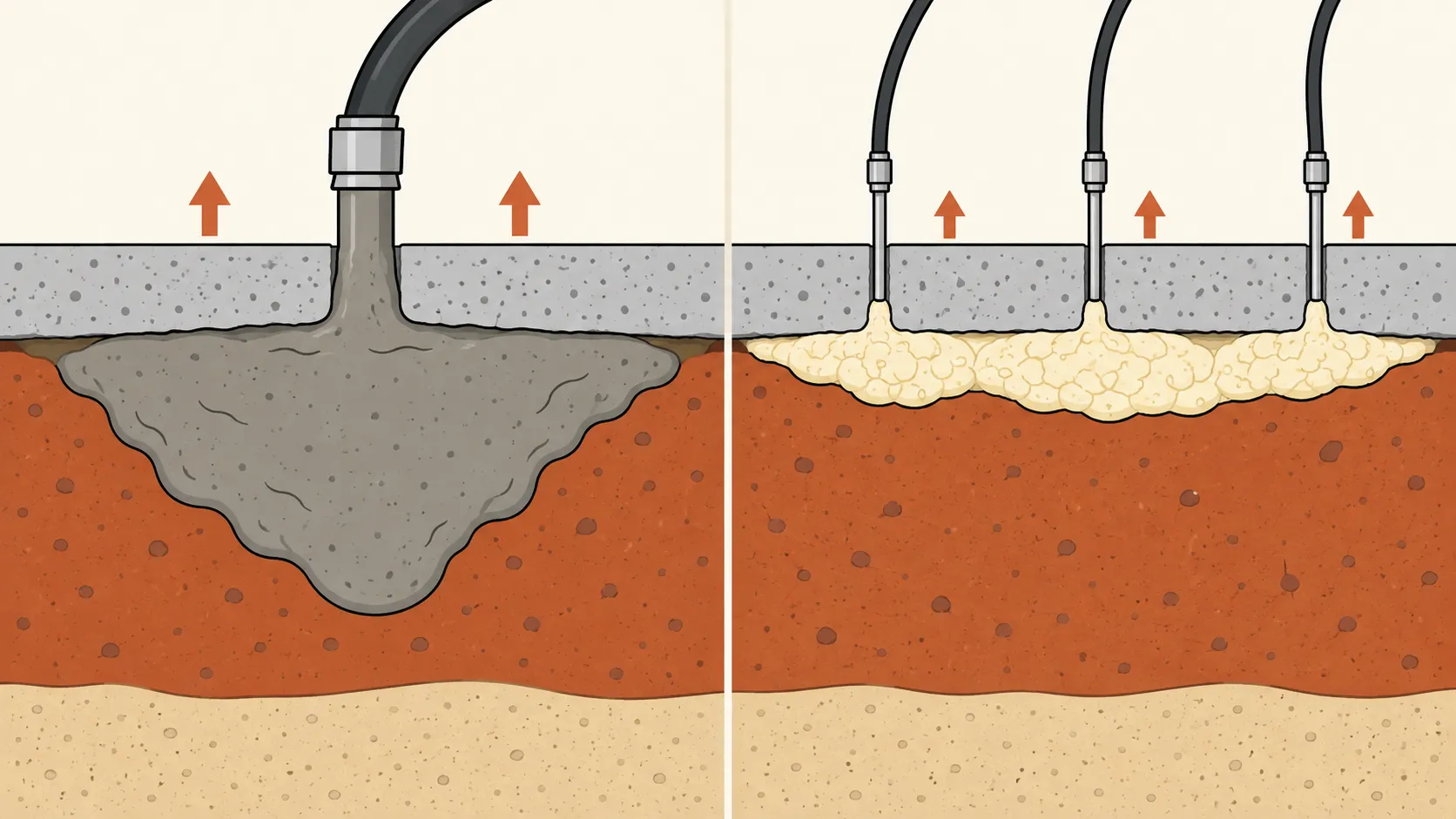 MudjackingPolyurethane foam
| Compared | Mudjacking | Polyurethane foam |
|---|---|---|
| What goes under the slab | A slurry of water, cement, and sand or soil | Expanding polyurethane foam |
| Holes in the slab | Larger | Smaller |
| Weight added to the soil | Heavy | Light |
| Price per sq ft (US) | $3 - $8 | $5 - $25 |
| Typical job (US) | $661 - $1,873 | $1,500 - $4,500 for a 300 sq ft section |
| How deep it reaches | Shallow, in the soil right under the slab | Shallow, in the same soil |
| Main risks | Over-injection can bulge or crack the slab; slurry can enter cracked utility lines | The same 2 risks |
Prices are national figures from Angi's 2026 cost guides (mudjacking updated Aug 2026, foam updated Sep 2026). The depth and risk rows come from the Foundation Performance Association's repair committee paper.
The weight row matters most on soft ground. Fixr's cost guide notes that heavy cement-based fill can sometimes make the problem worse by adding weight to unstable soil, one reason foam gets chosen for a slab over weak ground.
What the 2 methods share matters more than how they differ. Both are shallow, so both sit in the same active soil that let the slab sink. Whichever one lifts the slab, the clay underneath keeps responding to water the way it did before.
What mudjacking and foam cost
Mudjacking is the cheaper of the 2 up front. Nationally, a typical mudjacking job runs about $500 to $1,900, and foam usually costs more per square foot.
| Job | Typical cost (US) | Source |
|---|---|---|
| Mudjacking, typical job | $661 - $1,873 (average $1,234) | Angi, Aug 2026 |
| Mudjacking or slab jacking, typical range | $500 - $1,900 | Fixr, Jan 2026 |
| Mudjacking, per sq ft | $3 - $8 | Angi, Aug 2026 |
| Mudjacking, small-job minimum | Around $500 | Angi, Aug 2026 |
| Foam (polyjacking), per sq ft | $5 - $25 (average $15) | Angi, Sep 2026 |
| Foam, 300 sq ft section | $1,500 - $4,500 (average $3,000) | Angi, Sep 2026 |
| Foam under a house slab | About $25 per sq ft | Angi, Sep 2026 |
The per-square-foot price drops as the job gets bigger, and a small job often hits the minimum charge. Foam under a house slab sits at the top of its range, because the work is enclosed and the slab carries the house.
Against replacing the concrete, mudjacking usually wins on price. InterNACHI puts it at roughly half the cost of replacement, since no old concrete comes out and little new cement goes in.
Closer to home, one Oklahoma franchise of a national repair chain publishes an average of $1,000 to $3,000 for residential foam injection, inside the national foam range. Average Cost $1,000 - $3,000 (residential price range only)Source ↗
For the full OKC price picture across every repair type, with dated homeowner reports, see the cost guide.
When mudjacking is the right call, and when it isn't
Mudjacking fits one situation well: a sound slab that dropped because the ground under it settled or washed out, and has since stopped moving.
Good candidates
- A sidewalk, patio, driveway, or garage floor that sank in one area and is otherwise in good shape.
- A slab where the cause of the sinking, usually water, has been found and fixed.
- A job where replacing the concrete would cost far more than lifting it.
Poor candidates
- The slab rose instead of sinking. If expansive clay pushed the concrete up, pumping more material under it does not help. This one matters most in central Oklahoma.
- The concrete surface is crumbling, flaking, or badly broken.
- Nobody has dealt with why it sank.
- The ground under it is swampy, or there is a sinkhole.
- The slab already sits on repair piers and the soil there can still swell. The engineering standard says grouting and mudjacking should not go under an underpinned foundation if that swelling could damage the house.
The poor-candidate list follows InterNACHI's mudjacking guide; the underpinned-slab rule is from the ASCE Texas Section guidelines.
Central Oklahoma clay swells when it gets wet and shrinks when it dries, so a slab can be pushed up in one season and drop in another. Before anyone lifts a slab, find out which way it moved. The OKC soil guide explains why the local ground does both.
Sizing up a particular driveway, patio, or walk? The slab leveling guide covers which slabs qualify, how to tell which way yours moved, and what each slab costs to lift.
How long mudjacking lasts
There is no honest fixed number of years. How long mudjacking lasts depends more on the soil under the slab than on the slurry.
The Foundation Performance Association's repair committee groups mudjacking and foam together as shallow repairs affected by active, moving soil. If the moisture in that soil changes, the slab can move again.
The cost guides point the same way. Angi says foam can outlast the concrete it lifts, but only when the drainage problem is fixed at the same time, and that mudjacked slabs can settle again when soil or water problems persist.
So the lifespan question is really a water question, which is the next section.
Fix the water before the lift
Whatever lifts the slab, the water around it decides whether the slab stays put.
The engineering standard backs trying drainage, watering, and vegetation fixes before or instead of structural repair. The repair committee adds that poor drainage can keep a repaired slab moving. In practice that means:
- Gutters and downspouts that carry roof water well away from the slab.
- Soil graded so rain runs away from the concrete.
- Steady watering near the foundation in a drought, so the clay doesn't shrink hard.
- An eye on large trees close to the house, which pull moisture out of the clay.
Ask any mudjacking or foam contractor the same question: what is the plan for the water under this slab? A good answer names the drainage fix. If there is no answer, the lift may be temporary.
◆ Before anyone drills
Settle which way it moved first
For a sidewalk or patio, a reputable mudjacking contractor can size the job. For the slab your house stands on, the first question is whether it sank or was pushed up, and that is an engineer's call.
An independent structural engineer's report runs $200 to $500. It names the problem and the method, from someone with no repair to sell. In OKC, one homeowner's engineer inspection and detailed report came to about $200 plus $200. Gary McCracken with Metro Engineering did fine work. Nice guy; makes things easy to understand. Not sure what his prices are now, but when I used him, it was just shy of $200 for the inspection and summary and another $200 for the detailed report, diagram, etc.Source ↗
Read the engineer-first guide →Want a price on your slab? 1 OKC contractor, not 5.
Free to you. The contractor pays us a referral fee, never a markup.
FAQ
How much does mudjacking cost?
Nationally, most mudjacking jobs cost about $661 to $1,873, with an average around $1,234, according to Angi's 2026 cost data; Fixr puts the typical range at $500 to $1,900. Priced by area, mudjacking runs about $3 to $8 per square foot, and small jobs often carry a minimum charge near $500. Polyurethane foam costs more, about $5 to $25 per square foot. These are national figures, so treat them as sizing; an OKC quote can land higher or lower.
Does mudjacking really work?
Yes, on the right slab. Mudjacking lifts a sound slab that sank because the ground under it settled or washed out, and it usually costs about half as much as replacing the concrete. It is the wrong tool when swelling clay pushed the slab up, when the concrete is crumbling, or when nobody has fixed the water that caused the sinking. Because it is a shallow repair, it holds only as long as the soil under it stays stable.
How long is mudjacking good for?
There is no fixed number of years. Mudjacking and foam are shallow repairs that sit in the same soil that let the slab sink, so if the moisture in that soil changes, the slab can move again. The lift holds longest when the drainage problem is fixed at the same time. Ask any contractor what the plan is for the water under the slab, and what the warranty covers if it settles again.
Can you do mudjacking yourself?
It is possible on a small outdoor slab, but rarely worth it. Angi puts DIY equipment rental and materials at $500 to $1,200, close to what a pro charges for a small job, and a mistake can lift the slab unevenly or crack it. Foam jacking is out of reach for most homeowners, because the equipment generally can't be rented. For the slab under a house, leave it to a professional after the cause has been diagnosed.
Is polyurethane foam better than mudjacking?
Foam needs smaller holes and adds less weight to the soil, which helps on weak ground, but it costs more: about $5 to $25 per square foot against $3 to $8 for mudjacking. Both are shallow repairs with the same 2 risks, over-injection that can crack the slab and material leaking into cracked utility lines under it. For most slabs the bigger decision is fixing the water, since that decides how long either one lasts.